
Getting a Gate Ready for Winter in Loveland
Winter is when a gate’s small problems become big ones. Cold thickens grease and drains batteries, snow and ice fill tracks and swing paths, and freeze and thaw move the ground under posts. A gate that is a little slow or a little stiff in October is often the one stuck across the drive in January. A fall check takes care of most of it while the ground is dry and the days are still long.
Is the Gate Ready?
Winter Readiness Check
Answer each question for your gate. Not sure counts as no.
Answer the five questions, then press the button.
Signs to Watch for in the Fall
More columns to the right: swipe.
| Symptom noticed in fall | Likely cause | Fix |
|---|---|---|
| Slow travel on cold mornings | Backup battery losing capacity, thick old grease | Load-test or replace the battery; clean and re-grease the moving parts |
| Gate dragging at the bottom | Worn hinges, a sagging frame, or a post that has moved | Re-hang or re-hinge the gate; brace or reset the post |
| Panel rubbing the post | Post leaning, gate out of square, loose hinge bolts | Straighten and brace; tighten or replace the hinges |
| Solar operator stalling | Panel shaded or dirty, battery near the end of its life, shorter days | Clean and re-aim the panel; replace the battery; review the panel size |
| Latch not catching | Gate sag or post movement throwing the latch out of line | Level the gate, then realign the latch and keeper |
Before the Visit
- Clear vegetation, leaves and debris from the track, the swing path and around the photo eyes
- Mark the gate’s path for whoever plows, with stakes or reflectors, so snow is not banked against it
- Check the battery’s condition and the backup: note how the gate runs with the power off, if you know how
- Test the safety sensors: with the gate closing, pass something through the photo-eye beam and watch it reverse
- Photograph rubbing marks or uneven gaps and email them to info@centerragatesdoors.com
Snow Load, Ice and Ground Heave
Snow load. Wet spring and fall snow is heavy. It loads the top rail of a solid or ornamental gate, packs against its bottom, and drifts into the swing arc, so the opener meets far more resistance than in summer.
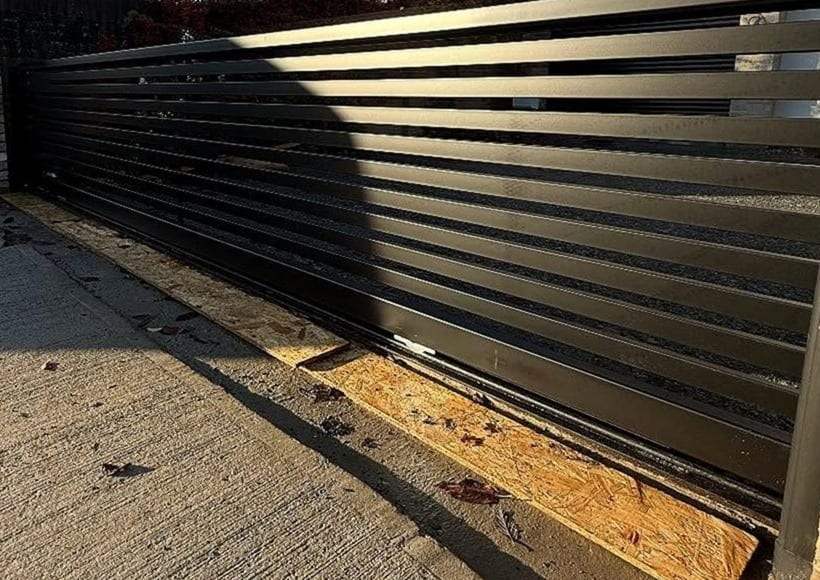
Ice in tracks. A sliding gate’s ground track collects meltwater that freezes overnight. Rollers ride up on the ice or freeze in place. Keeping the track clear after each storm, and checking the rollers in the fall, prevents most of it.
Ground heave. Freeze and thaw lift posts, footings and the concrete under tracks. A little ground clearance under a swing gate and posts set below the frost line leave room for the season’s movement.
Through the Snowfall
How do we keep a gate usable through a snowfall?
Clear the path before running the gate, not after it stalls. Shovel the track or the swing arc, brush snow off the photo eyes and any solar panel, and keep plowed snow from being banked against the gate. On a heavy storm day, a gate left open on its hold-open setting, where the opener has one, avoids running it through deep snow. If the gate struggles, stop it rather than letting the opener push.
Should salt or de-icer go on the track?
Use it sparingly, if at all. Salt speeds rust on steel tracks, rollers and the bottom rail. Clearing by hand and keeping water from pooling in the track works better over a winter.
Book a Fall Check
Call or send the request form before the first snow. Mention the gate type, the opener, and anything the readiness check turned up.